
Power Your AI GTM Strategy by Recording Customer Phone Calls
To build an effective AI-driven Go-To-Market (GTM) strategy, start by recording customer calls.

Most companies record thousands of sales calls monthly but extract zero systematic insights from them. Every sales call, support conversation, and customer interaction contains insights that could transform your go-to-market strategy.
The missed opportunity costs companies millions in unrealized revenue. See data from Gong showing hidden patterns most revenue teams overlook.
The advantage goes to companies that route call insights directly into Salesforce workflows, HubSpot sequences, and Gong coaching programs within 24 hours of each conversation.
The Data Foundation For GTM Intelligence
Call analysis reveals which objections kill deals, which features drive expansions, and the winning talk tracks used by top closers. Using these insights, your revenue team can quickly adjust playbooks and address gaps before they impact the pipeline.
- 35% improvement in lead qualification accuracy through AI-powered systems
- 30-50% reduction in sales cycle length as teams identify optimal conversation patterns
- 25-40% improvement in customer retention through early warning signal detection
How Call Intelligence Flows Through Your GTM Organization
Churn Reduction: When customer calls reveal early warning signals like onboarding frustration or competitor mentions, AI instantly routes these insights to Customer Success for immediate intervention. Product teams receive aggregated friction patterns for roadmap prioritization. Marketing updates competitive positioning based on actual objections heard in real conversations.
Case study: 38% churn reduction in six months. By removing filler claims and focusing on the data, the value is clear without overstating results.
Problem Identification: Customer calls revealing recurring feature requests flow systematically through your organization. Sales teams capture the initial insight. Product Marketing updates competitive battlecards and positioning materials. Product teams prioritize roadmap items based on revenue impact and frequency of mentions. Sales Enablement creates improved objection handling scripts using proven responses from successful deals.
Companies addressing AI-identified issues see up to 25% improvements in NPS scores compared to organizations relying on traditional feedback methods.
Message Optimization: When customer language differs from marketing materials, the insight flows strategically across teams. Marketing updates website copy and campaigns using actual customer vocabulary. Sales revises talk tracks and email templates with high-converting language patterns. Product Marketing realigns the entire messaging framework with authentic customer pain point descriptions.
Conversational marketing techniques produce 42% increases in conversion rates compared to traditional digital advertising across all touchpoints.
Team Performance: Top performer conversation patterns identified in calls create a systematic knowledge transfer system. Sales Management develops coaching programs based on winning behaviors. Sales Enablement updates training content with proven conversation patterns. Revenue Operations aligns performance benchmarks and compensation with documented best practices.
Organizations using conversation intelligence achieve 179% quota attainment from new representatives through this systematic approach to scaling successful behaviors.
How do we start without rebuilding our tech stack?
Begin by recording every customer call, export transcripts via API, and load them into a dashboard (Google Sheets works). Use Clay to match call IDs to CRM records and trigger simple Slack alerts. Iterate weekly—don’t wait for a “perfect” rollout.
Transform your call data into revenue growth through three immediate actions: First, integrate real-time call analytics into your lead scoring via Gong or Chorus. Second, cross-reference findings with segmented data from 6sense or Clearbit to improve ICP accuracy. Third, schedule weekly cross-functional reviews to act on new insights. Start small, measure results, and iterate.

Founder & Principal, SandsDX (AI-First GTM Consulting)
Helping B2B teams scale by removing friction through simplicity and systems thinking.


Related Blogs Post
AI Competitive Intelligence: How to Automate Competitor Tracking
Learn how to automate competitive intelligence with AI agents. Track competitor signals, analyze messaging shifts, and turn insights into GTM action with automated monitoring systems.

Signal-Based Marketing with AI: Complete Implementation Playbook
Learn how to implement signal-based marketing with AI agents. Includes 15+ trackable buying signals, automated response plays, real examples, and ROI measurement framework.
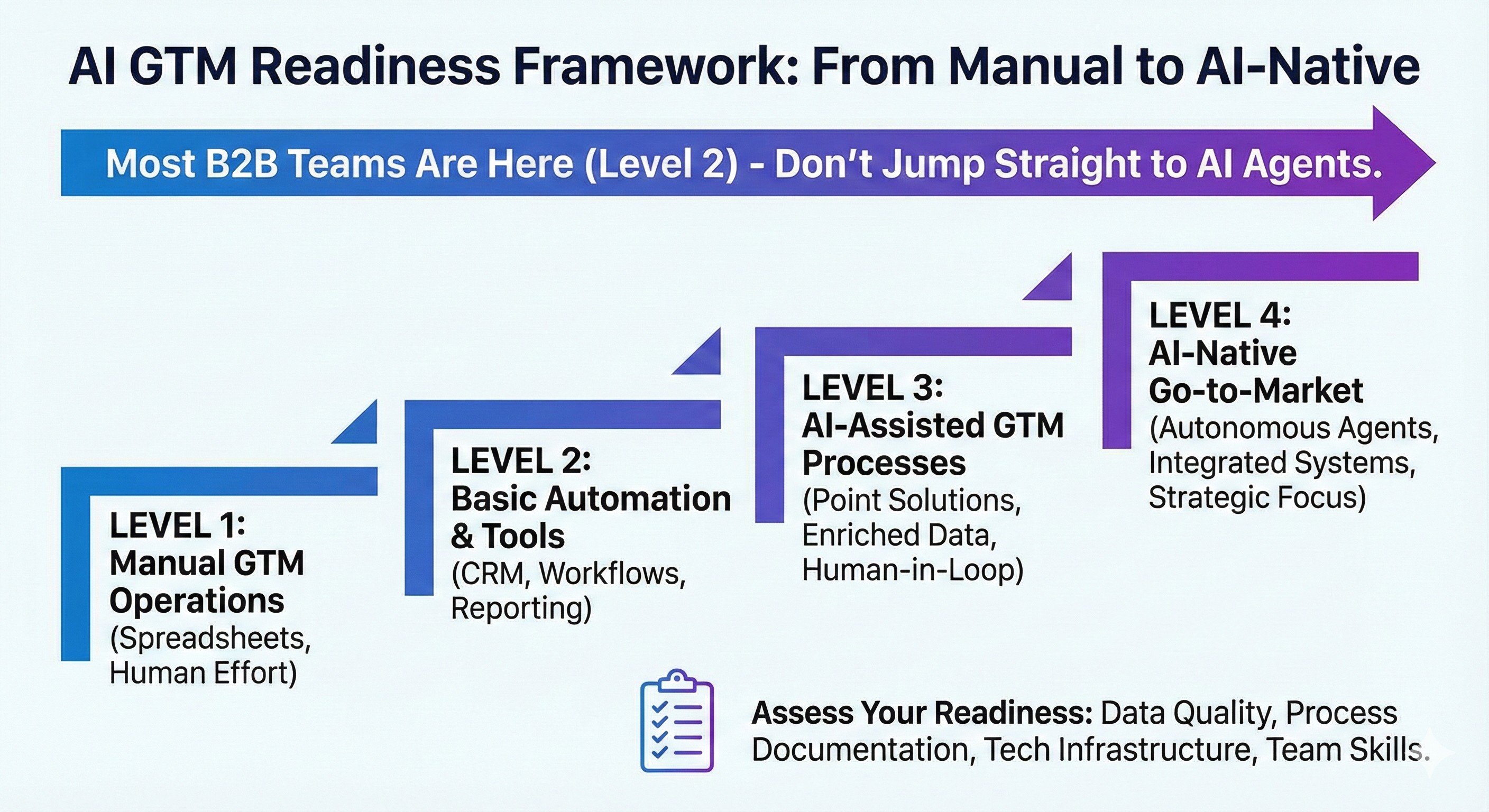
AI GTM Readiness Assessment: Is Your Team Ready for AI Agents?
Assess your team's readiness for AI agents with our 4-level GTM maturity framework. Learn where you stand and get a clear roadmap to AI-native go-to-market operations.

How to Build an AI Copilot for Demand Generation [2025 Guide]
Step-by-step guide to building an AI copilot for demand generation. Learn which platform to choose, how to set up integrations, and how to automate your demand gen workflow.

AI for B2B Sales Enablement: Complete Guide 2025
Learn how AI transforms B2B sales enablement with tools for call prep, competitive battle cards, and content creation. Includes implementation roadmap and ROI measurement framework.

AI Agents for B2B Marketing: Complete 2025 Guide
Discover how AI agents transform B2B marketing operations. Learn about 8 types of marketing AI agents, real implementation examples, and how to choose the right tools for your team.
How I Stopped Generating AI Slop by Training Claude with Custom Skills
Building reusable "skills" for Claude eliminates repetitive prompting by encoding your style guidelines and standards into instruction files that load automatically. This systematic approach delivers consistent outputs and competitive advantage while competitors waste time with generic prompts.
OpenAI's AgentKit Proves We're at the Railroad Moment for Software
OpenAI's AgentKit launch proves AI agents are disrupting SaaS. Learn how marketing myopia explains why traditional software companies must redefine their business models or face obsolescence.
OpenAI AgentKit Just Reset AI GTM
OpenAI's AgentKit announcement on October 6, 2025 changed the conversation from "Can AI improve GTM?" to "How fast can you ship production agents?"

From AI Tool Sprawl to Strategic Networks: A Schön-Inspired GTM Framework
Despite 70% AI adoption in GTM workflows, companies struggle with conversions. This framework shows how to move from isolated AI tools to interconnected systems that deliver measurable results.

AI Agent Strategy: Your Guide to GTM Excellence
The go-to-market landscape has fundamentally shifted. Today's top-performing organizations are leveraging AI agents to create competitive advantages, achieving outcomes to impact time savings per rep, increasing account coverage, and pipeline.

Signal-Based GTM: Key Insights from Clay's Sculpt 2025 in San Francisco
The AI hype in sales is settling into practical results. Companies are saving reps 10+ hours per week, hitting 72% account coverage instead of 19%, and building entirely new roles to make it happen.

AI Agents for GTM teams